Part VI - Production Engineering
Chapter 28 - Threat Model and Security Architecture
A threat model connects assets, actors, trust boundaries, attack paths, and mitigations. It should be updated as the product adds public links, device commands, proof files, or new protocol listeners.
Assets
High-value assets include:
- exact current and historical locations;
- person-subject identity and relationships;
- device and API credentials;
- authentication signing keys;
- private-zone definitions;
- task and recipient details;
- proof-of-delivery files;
- device commands;
- audit and access history;
- backup archives.
Availability is also an asset. A safety or delivery platform can be harmed by data loss, delayed alerts, or false positions even without confidentiality loss.
Trust boundaries
Important boundaries include:
- public Internet to Nginx;
- browser to REST and WebSocket APIs;
- mobile web layer to native bridge;
- device networks to GPS listeners;
- Go processes to PostgreSQL;
- application to filesystem storage;
- worker to external webhook or email endpoints;
- primary database to backup destination;
- operator access to production systems.
Document what is authenticated, encrypted, rate-limited, and audited at each boundary.
Principal separation
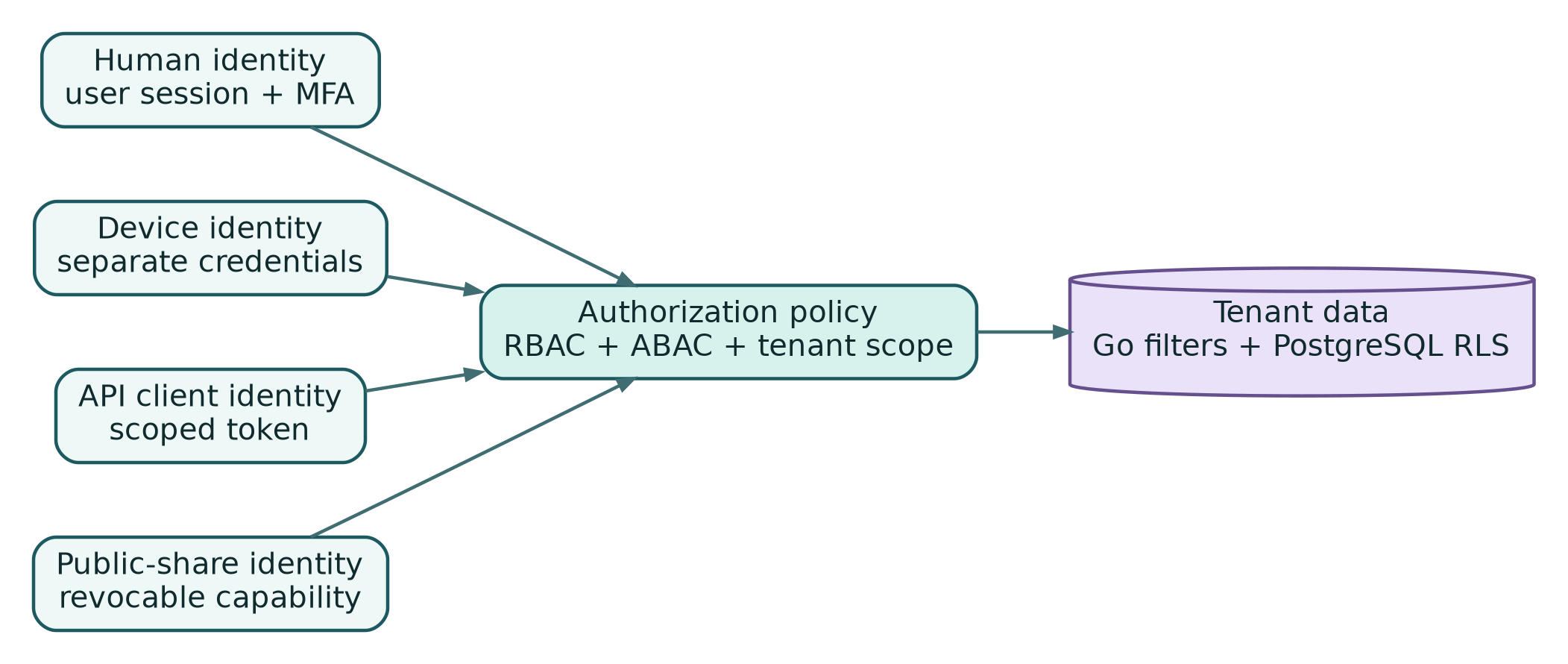
Different identities have different blast radii:
- a human user acts through organization membership and policy;
- a tracking device can submit only for authorized subject/session scope;
- an API client has organization and action scopes;
- a public capability has a narrow view scope;
- an internal process uses a database role and system policy.
Never transform one principal into a more powerful one because it is convenient in middleware.
Attack scenarios
Representative scenarios include:
- Cross-tenant object reference - an authenticated user changes a subject ID in a URL.
- Stolen refresh token - an attacker attempts reuse after legitimate rotation.
- Compromised device credential - false locations are uploaded for an assigned subject.
- Replay of old GPS frames - a valid packet is resent to fabricate history.
- Public-link leakage - a token appears in browser history or referrer headers.
- WebSocket subscription escalation - a client subscribes to another team.
- SSRF through webhook URL - the worker is induced to call an internal service.
- Malicious proof file - an image decoder or spreadsheet export is attacked.
- Slow TCP client - a connection consumes a goroutine and buffer indefinitely.
- Backup theft - encrypted or unencrypted archives expose long-term history.
- Insider access - support or operations staff view precise routes without purpose.
- Location inference - even rounded public points reveal a home over time.
Every scenario receives preventive, detective, and recovery controls.
Input validation
Validation is centralized by contract but remains defense in depth:
- HTTP body and frame limits at Nginx and application layers;
- strict JSON decoding with controlled unknown-field policy;
- finite numeric checks;
- file type and decompression limits;
- geometry complexity limits;
- URL and DNS validation;
- bounded metadata;
- parser fuzzing;
- database constraints.
Do not trust generated clients as a security boundary.
Secret management
Use mounted secret files or Docker secrets with strict permissions. Configuration references file paths. Processes read secrets at startup or through a controlled reload mechanism.
Rotate:
- access-token signing keys;
- refresh and device credential policies;
- webhook secrets;
- database passwords;
- backup encryption keys;
- TLS keys.
A rotation runbook includes overlap, verification, rollback, and secure retirement.
Network security
Only Nginx and explicitly required GPS ports are public. PostgreSQL binds to a private network and uses TLS where traffic leaves a trusted host boundary. Host firewalls allow only required paths. Administrative access uses separate accounts, MFA, and auditable elevation.
Container networks are not a substitute for firewall policy. The production Compose topology should not publish database ports to all interfaces.
Supply chain
The release process should:
- pin dependencies and toolchains;
- verify checksums;
- run static analysis and tests;
- generate an SBOM;
- scan containers and source;
- build minimal images;
- sign release artifacts where practical;
- record provenance;
- prevent unreviewed generated changes.
A vulnerability scan is an input to risk decisions, not a guarantee.
Security tests
Automate:
- cross-tenant endpoint and direct-SQL tests;
- token reuse and rotation tests;
- authorization parity across REST, WebSocket, exports, and jobs;
- fuzz tests for APIs and protocols;
- SSRF fixtures;
- malicious file fixtures;
- rate-limit and resource-exhaustion tests;
- secret scanning;
- dependency and container policy checks;
- backup restoration and key availability.
Chapter checklist
The security architecture should have:
- a maintained asset and trust-boundary model;
- separate principal types and credentials;
- scenario-based controls;
- bounded input at every exposed parser;
- executable key-rotation procedures;
- private database and administrative networks;
- release provenance and SBOMs;
- automated tenant, protocol, and abuse tests.