Chapter 16 - WebSocket Realtime Without Redis
A live map needs low-latency deltas, but accepted location data must remain durable even when no client is connected. The design combines a REST snapshot, durable outbox events, PostgreSQL wake-up notifications, and in-process WebSocket hubs.
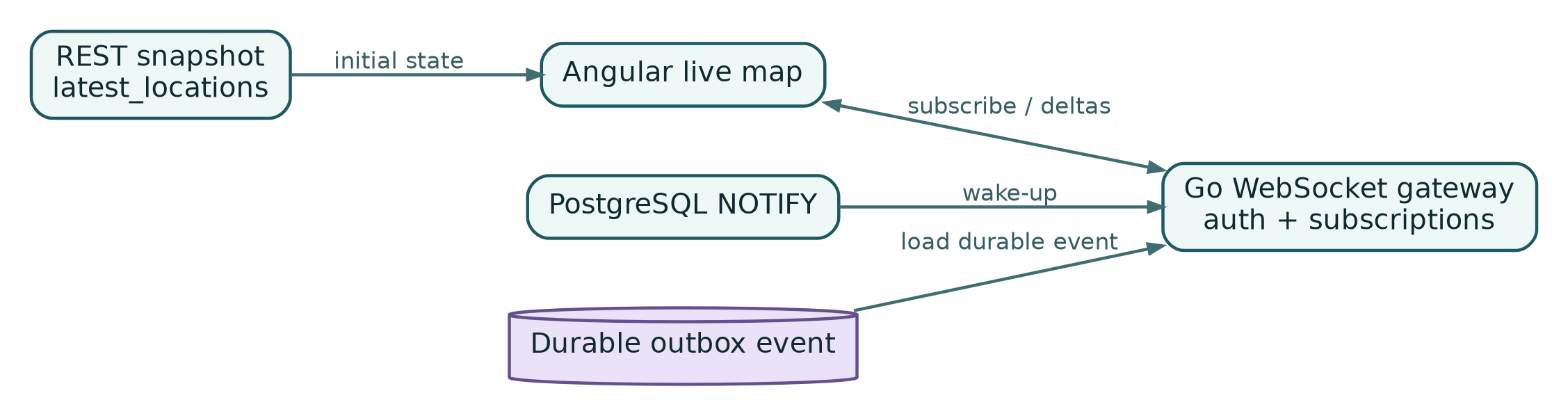
Snapshot plus delta
A client connection follows this sequence:
- authenticate the human, API client, or public capability;
- request a REST snapshot of authorized subjects and versions;
- open a WebSocket connection;
- subscribe to organization, team, subject, or public scopes;
- provide the snapshot high-watermark;
- receive any missing durable deltas;
- continue with live deltas.
This avoids treating the WebSocket as the source of truth. A reconnect can always recover from a snapshot or event cursor.
Protocol envelope
Version every message:
{
  "protocol_version": 1,
  "type": "location.updated",
  "message_id": "0195...",
  "occurred_at": "2026-10-10T10:11:13.101Z",
  "channel": "subjects:0195...:live",
  "sequence": 883,
  "payload": {
    "subject_id": "0195...",
    "recorded_at": "2026-10-10T10:11:12Z",
    "latitude": 44.8123,
    "longitude": 20.4611,
    "speed_mps": 5.8,
    "heading_deg": 182,
    "movement_status": "moving",
    "connection_status": "online"
  }
}
Client messages include subscribe, unsubscribe, ping, and acknowledgement or cursor messages when the protocol requires them. Invalid messages receive a bounded error and can close the connection after repeated abuse.
Authorization at subscription time
Do not authorize only the socket handshake. Each subscription is evaluated against current policy. A role change, team removal, public-link revocation, or session completion may require active subscriptions to be removed.
Channels are logical, not secrets:
organizations:{organization_id}:live
teams:{team_id}:live
subjects:{subject_id}:live
sessions:{session_id}:live
public-links:{share_id}:live
Knowing a channel name does not grant access.
Event propagation between replicas
Every API replica listens for outbox notifications. The notification contains an event ID or high-watermark. The replica loads the durable event, evaluates which local subscribers may receive it, and enqueues a compact message.
If a replica misses a notification, periodic reconciliation reads events after its last processed cursor. If an event has already fallen outside the realtime replay window, clients fall back to a new snapshot.
The event table can retain realtime events for a limited interval after all critical consumers process them. Do not delete based only on one replica's cursor.
In-process hub
A hub manages local connections and subscriptions. It must be bounded:
type Client struct {
    ID        string
    Principal Principal
    Send      chan []byte
    Closed    chan struct{}
}

type Hub struct {
    register   chan *Client
    unregister chan *Client
    subscribe  chan SubscriptionRequest
    publish    chan Event
}
A single goroutine can own hub maps, or sharded hubs can reduce contention. Never let publishers block indefinitely on a slow client.
Backpressure and coalescing
A dashboard does not need every high-frequency point for every marker. Coalesce location updates per subject and send the newest state at a configurable cadence, for example 250 milliseconds to 2 seconds.
Message classes need different treatment:
- current location updates can be coalesced;
- SOS and alert transitions must not be dropped;
- role or revocation events must be delivered promptly;
- bulk history does not belong on the realtime channel.
Each connection has a bounded send queue. When it fills:
- discard superseded coalescible updates;
- preserve critical control messages;
- if still overloaded, close the client with a retryable reason.
A slow browser must not consume unbounded memory.
Heartbeats and reconnect
Use protocol-level ping/pong or application heartbeats. Close dead connections after a documented timeout. Clients reconnect with exponential backoff and jitter, not a tight loop.
The client maintains:
- connection state;
- last snapshot version;
- last processed message or subject version;
- active subscription intents;
- server time offset when useful.
After reconnect, it reauthenticates, refreshes expired access tokens, obtains a snapshot or replay, and then restores subscriptions.
Graceful shutdown
During deployment:
- readiness becomes false;
- new connections stop;
- existing clients receive an optional restart notice;
- the process drains outbound queues for a bounded interval;
- sockets close with a retryable code;
- database listeners and cursors stop cleanly.
Test rolling replacement with thousands of reconnecting clients. A deployment should not create a self-inflicted reconnect storm that overwhelms authentication and snapshot queries.
Security
Protect the WebSocket endpoint with:
- origin validation for browser clients;
- access-token expiry and refresh behavior;
- message and subscription rate limits;
- maximum frame size;
- read and write deadlines;
- compression limits or disabled compression where risky;
- authorization for every scope;
- no secrets or exact coordinates in normal logs.
Chapter checklist
Realtime is production-ready when:
- clients use snapshot plus delta;
- messages and channels are versioned;
- every subscription is authorized;
- replicas load durable events after wake-up signals;
- missed notifications are reconciled;
- queues are bounded and locations are coalesced;
- reconnect and graceful shutdown are load-tested;
- critical events are not treated like disposable marker updates.