18. Bind Authorization and Approval to the Exact Action
Part V — Tool Governance
A policy decision answers whether a particular actor may perform a particular action on a particular resource under current conditions. “This agent is trusted” is too broad to be a useful decision. Tool permissions should include server, tool, actor, scope, input constraints, policy version and time bounds.
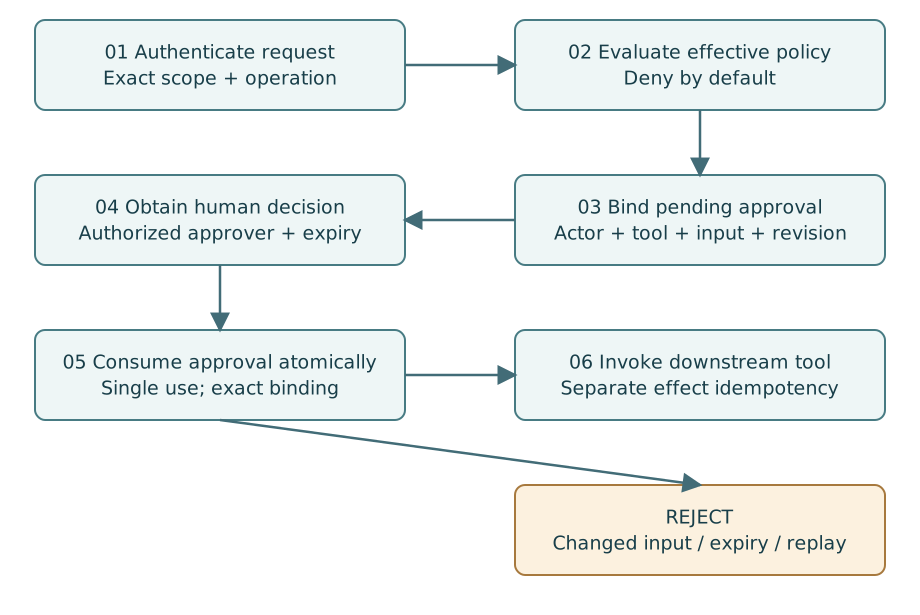
Define deterministic policy precedence
Start with deny by default. An explicit organization-level denial cannot be weakened by a project rule. Distinguish allow from require approval: an approval requirement is not a temporary allow. Invalid policy and unavailable evaluation must produce a defined failure, generally fail closed for privileged actions.
Use a constrained, reviewed policy language or typed rules. Do not evaluate arbitrary user-provided code in the authorization service. Bound expression complexity and input size. A policy engine can become a denial-of-service surface if one decision can consume unbounded CPU or memory.
Construct a decision identity
The decision should bind actor, organization, project, sandbox, tool server, tool name, tool schema version, normalized input digest, policy version and expiration. Canonicalize inputs according to a documented format. Do not hash whatever JSON serialization a client happens to send and assume semantic identity is stable.
A digest can also reveal low-entropy sensitive inputs through guessing. Keep approval metadata minimal, use a keyed digest where appropriate to the threat model and avoid exposing unnecessary input hashes to unrelated users. Human approvers still need enough safe context to make an informed decision.
Model approval as a durable state machine
A request can be pending, approved, rejected, expired, canceled, reserved for an execution or consumed. Define allowed transitions and use conditional updates under concurrency. If two approvers decide simultaneously, one authoritative result wins and the other receives a conflict.
A policy requiring four eyes must prevent requester self-approval and verify the approver's current authority. Consider organizational ownership: two accounts controlled by one person may satisfy a technical two-account check without providing genuine independent review. Communicate the exact implemented rule.
Consumption does not mean exactly-once side effects
Reserve an approved action for a stable execution ID before dispatch. A retry for the same execution can observe that reservation. A request for a different execution or changed input is rejected. If the tool effect happens and the result is lost, the system still needs downstream idempotency or reconciliation. One-time approval prevents reuse of authority; it does not magically make every external tool effect exactly once.
Do not keep an HTTP request open for hours while waiting for a person. Return an approval-required result, expose the pending request and let the agent resume or retry with the same operation identity after a decision. Bound approval lifetime and revalidate relevant policy changes before execution.
Prevent bypass
Authorization must be applied where the request cannot route around it. If the sandbox can directly call the tool with a powerful credential, an approval UI is only advisory. Combine gateway enforcement, downstream identity checks and network restrictions. The server should reject credentials for the wrong audience or scope. S10
A gateway timeout must not default to allow. For non-privileged read operations, a carefully designed cached decision may be acceptable, but its scope, version and maximum age must be explicit. Security-sensitive policy changes should invalidate or constrain cached decisions.
Audit decisions without collecting everything
Record the decision ID, safe action description, policy version, approver, outcome, reservation identity and timestamps. Raw tool arguments often contain customer data. Use approved summaries and protect detailed evidence separately when retention is genuinely necessary.
Exercise
Test changed input, changed tool schema, expired approval, revoked approver, concurrent consumption and a lost result after dispatch. Explain which failures return denied, conflict, expired or unknown. Then verify that no rejected case reaches the mock tool server at all.