09. Make Delivery Durable Without Promising Exactly-Once Effects
Part II — Control Plane
The messaging contract must survive duplication, reconnects and uncertain results. NATS JetStream provides persistence and delivery mechanisms, but an acknowledged message is not proof that an external business operation happened exactly once. The application still owns effect identity and reconciliation. S09
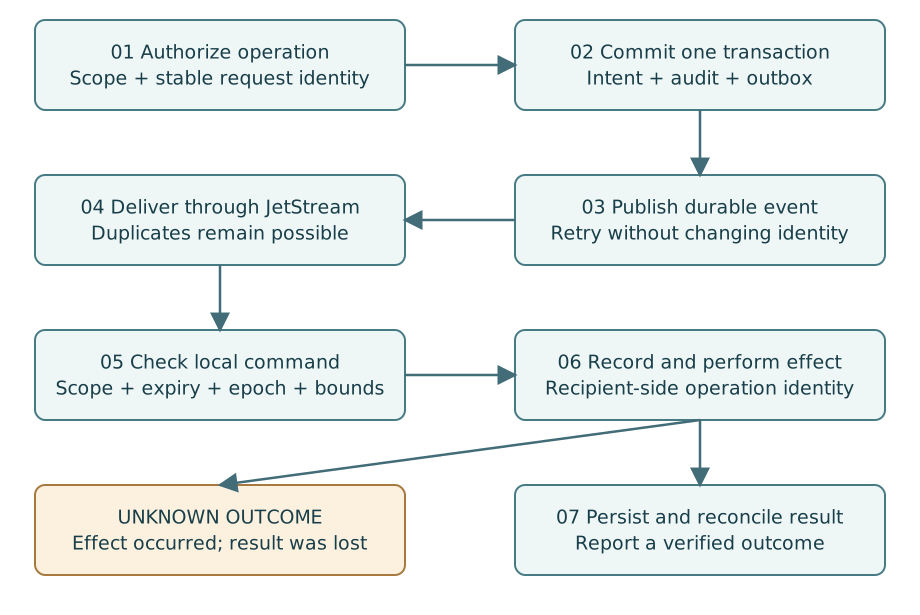
Commit intent and an outbox event together
The API transaction writes the operation record, quota reservation, audit metadata and an outbox event. A worker later publishes the event. If publication succeeds and the worker crashes before marking the outbox row delivered, publication may repeat. Consumers therefore need deduplication. This is the intended behavior, not an exceptional corner case.
Keep the outbox immutable enough to replay deterministically. Track attempts and
lease ownership separately from the event body. Bound batch size and lock
duration. Use FOR UPDATE SKIP LOCKED or a carefully designed equivalent for
worker claiming, then release database transactions before slow network work.
A lease expiration permits recovery but does not prove the previous worker stopped.
Use distinct identifiers
An operation ID identifies the user-visible intent. A command ID identifies a particular dispatchable instruction. A message ID identifies a transport event. An execution ID identifies a runtime action. A trace ID connects observability. These IDs are related but not interchangeable.
For example, the same command can be delivered in multiple transport messages. An operation can contain a create command and a later cleanup command. A trace can be sampled away without erasing execution identity. Keeping these concepts separate avoids accidental coupling between billing, tracing and correctness.
Model command state durably
A connector may observe accepted, started and finished states. A durable journal can return the original result for a repeated completed command. However, a journal entry marked started does not prove whether the process ran before a crash. Use a runtime execution service with durable operation identity when available. Otherwise expose an unknown state and reconcile; do not automatically start a second copy.
Resource creation is often easier to reconcile than arbitrary execution. A stable Kubernetes resource name and ownership metadata let a repeated create observe the existing resource. For an arbitrary script calling a third-party API, a local annotation cannot make the third-party effect idempotent. That API must support its own idempotency or the workflow must handle uncertainty.
Coordinate connections, then fence effects
Only one logical connector connection should own a cluster stream. Maintain a monotonic connection epoch and reject stale command ownership. Kubernetes Leases are useful for leadership coordination, but they do not by themselves make every external action exclusive. S21
A stale worker may continue after losing a lease. The component performing the side effect must validate fencing or operation ownership in an atomic mechanism appropriate to that effect. A check followed by an unrelated action can still race. For Kubernetes updates, resource versions help with concurrent state changes; for process starts, use a durable execution claim enforced by the runtime service. Document any effect for which strict fencing cannot be established.
Bound the transport
Set maximum message size, pending commands, per-cluster concurrency and output buffer size. Separate long output streams from the durable control journal. Storing megabytes of terminal output in every JetStream command result can turn a small execution into a fleet-wide memory and storage problem.
Set command deadlines and reject stale work on both sides. An old create request must not suddenly provision a session after a lengthy outage if its intent has expired. Dead-letter handling should preserve safe diagnostics and require a reviewed replay action; it must not be an automatic infinite retry loop.
Reconcile after interruption
When a connector reconnects, exchange its epoch, capabilities and a bounded set of operation summaries. Compare observed resources with current desired state. Do not replay every historical event as a new command. Use the database and resource identities to decide what is missing, stale, complete or unknown.
Exercise
Create a failure table for crashes before publish, after publish, after command receipt, after process start and after process completion. State which cases can be retried automatically and which need runtime reconciliation. The Go teaching examples illustrate local identity and state guards, not a distributed exactly-once execution engine.