13. Model Sessions, Executions and Uncertainty Separately
Part IV — Safe Execution
A session is a governed workspace and runtime identity. An execution is one action inside that session. An operation is the platform's attempt to change or use a resource. Combining all three into one status field produces contradictions: a session can remain healthy while one execution fails, and a termination operation can be pending while the last observed runtime is still running.
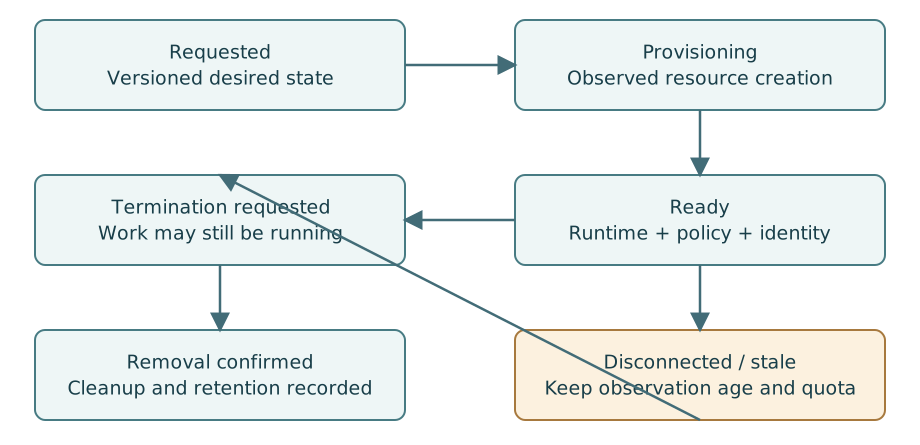
Start with a small state machine
Use a small explicit core: requested, provisioning, ready, terminating, terminated and failed. Add suspended and resuming only when the corresponding runtime semantics are verified. Record lost observation as a condition rather than pretending it proves termination. More states are useful only when they lead to different behavior or user action.
The Go example in examples/go-core implements an educational transition guard with stale-version rejection. It does not implement distributed reconciliation or Kubernetes execution. Its value is that terminal-state and version invariants can be tested without a cluster.
Desired termination dominates stale activity
Suppose a session is ready at intent version 7. The user requests termination, creating intent version 8. A delayed “resume” command from version 6 arrives after that. Both the connector and the resource manager should reject it as stale. A database state transition alone is not enough if the cluster still accepts old commands independently.
Use a stable resource identity and versioned intent. Every command includes the relevant intent version, deadline and scope. Terminal intent is durable; a reconnect cannot turn an expired or terminated session back into a running one merely because an older event said ready.
Readiness is a conjunction
A scheduled Pod is not automatically ready for execution. Readiness should include runtime health, required policy application, identity binding and the required workspace state. If a policy update is still pending, the platform must not expose a privileged execution endpoint under the assumption that the update will finish soon.
Keep provisioning failure reasons specific: scheduling, image policy, image pull, storage, runtime health, credential reference or unsupported capability. A generic “failed to start” message forces operators to obtain unnecessary raw cluster logs. Safe, structured reasons improve both support and privacy.
Termination is a workflow
Stop accepting new executions. Request cancellation of active work according to policy. Prevent new credential issuance. Revoke what the provider can revoke. Remove runtime resources, then apply workspace retention policy. Confirm cleanup before declaring resource removal complete.
A terminated process can leave completed external effects behind. A terminated session may retain a snapshot intentionally. A failed cleanup may leave a PVC. Represent these outcomes explicitly instead of treating termination as universal rollback and erasure.
Disconnection requires a local contract
A disconnected connector cannot receive new central policy. The cluster needs a local maximum lifetime, a command lease policy and a rule for continuing existing work. Depending on the customer risk model, existing sessions may continue for a bounded interval or stop promptly. Both approaches have availability and safety costs; neither should be an accidental consequence of network failure.
Do not release concurrency quota just because the control plane has lost contact. The workload may still be consuming resources. Mark capacity uncertain, retain a conservative reservation and reconcile when observations return. An administrative override may be necessary, but it should be visible and auditable.
Garbage collection must respect ownership
Identify orphans by stable labels, owner references and product IDs. Do not delete all resources with a common display-name prefix. Check that the candidate belongs to AgentPlane and that its retention policy allows deletion. Include a dry-run inventory and an approval step for destructive bulk cleanup.
A missing database row does not always imply a disposable resource: it may result from an incomplete restore. Recovery mode should quarantine or report ambiguous resources before deleting them. This matters during disaster recovery, when the control database may be older than the running cluster state.
Exercise
Implement tests for duplicate termination, stale resume, runtime disappearance, connector disconnect and restoration from an older database snapshot. For every case, specify the session state, operation state, quota reservation and cleanup obligation. A single state string should not be expected to carry all four.